How to Translate YouTube Subtitles: A Complete 2026 Guide for Viewers and Creators


YouTube subtitles unlock content that would otherwise sit behind a language barrier. For viewers, that means watching a Korean tutorial, an Arabic news clip, or a Persian podcast in your own language. For creators, it means a single upload reaching audiences in 100+ markets without re-recording or re-editing.
The tricky part is figuring out which translation method to use. YouTube's built-in auto-translate works for casual viewing but breaks on technical language, slang, and accents. Chrome extensions add side-by-side translations to the player but don't help if you want to publish translated subtitles back to YouTube. And if you're a creator, neither option produces the on-brand subtitle file you actually need to upload to your channel.
This guide covers every workflow: enabling YouTube's auto-translate, using a Chrome extension to watch with translated captions, and translating SRT files for upload as a creator. We'll also cover what to do when YouTube's auto-translate breaks, and how to translate a video that doesn't have subtitles in the first place.
Key takeaways
- Viewers can enable YouTube's built-in auto-translate by clicking the CC icon, then the gear icon, then Subtitles, then Auto-translate, and choosing a target language
- Chrome extensions like Dualsub or Translate and Speak Subtitles for YouTube show translated subtitles directly in the YouTube player without changing the original video
- Creators can translate their own YouTube subtitles by downloading the SRT from YouTube Studio, translating it in VEED's subtitle translator, and uploading the new file back to YouTube as a separate language track
- No subtitles on the video? Use a tool that combines auto-transcription and translation in the same workflow, like VEED's video translator, which generates subtitles from speech first, then translates
- YouTube's auto-translate breaks on technical terms, accents, and slang. For accuracy, translate the SRT in a dedicated tool and review the output before publishing

Quick comparison: which method should you use?
How to translate YouTube subtitles as a viewer
The fastest way to watch a YouTube video in your language is to use YouTube's own auto-translate feature. It's free, built into the player, and supports 100+ languages.
1. Enable subtitles on the video
Start by clicking the CC (closed captions) icon in the bottom-right of the YouTube player. If the creator added subtitles, they'll appear in the original language. If they didn't, YouTube generates them automatically using its own speech recognition. Auto-generated captions show up labeled "(auto-generated)" in the settings menu.
If the CC icon is greyed out, the video either has subtitles disabled by the creator or doesn't have enough clear speech for auto-captioning. In that case, skip to the section below on translating videos without subtitles.
2. Open the subtitles settings
Click the gear icon (Settings) in the bottom-right of the player, then click Subtitles/CC. You'll see the available subtitle tracks listed.
3. Click Auto-translate and choose your language
In the Subtitles/CC menu, click Auto-translate and select your target language. YouTube will translate the existing subtitles on the fly using Google Translate. The translation appears immediately and stays synced with the video.
This works on desktop and mobile. On the YouTube mobile app, tap the video, tap the three-dot menu, tap Captions, then choose Auto-translate.
Common reason auto-translate isn't showing up
If you don't see Auto-translate in the menu, the video probably doesn't have subtitles to translate from. YouTube can only auto-translate captions that already exist, either added by the creator or auto-generated. Some creators disable auto-captions entirely, especially for music videos or content with unclear audio.
How to translate YouTube subtitles using a Chrome extension
Chrome extensions are the most popular workaround when YouTube's built-in auto-translate isn't enough. They show translated subtitles directly in the player, often alongside the original language for language learners.
Dualsub
Dualsub shows two subtitle tracks at once: the original and your translation. It's the top-ranking option in the Chrome Web Store for YouTube subtitle translation and is free to install. Dualsub uses Google Translate, DeepL, or other translation engines depending on your settings.
Best for: Language learners who want to compare the original audio against a translation in real time.
Translate and Speak Subtitles for YouTube
This extension translates subtitles and reads them aloud in the target language. It's useful if you're multitasking or have visual accessibility needs.
Best for: Multitasking, accessibility, or learners who want to hear pronunciation alongside translation.
Things to know about Chrome extensions
- Extensions only work in the browser. They won't help on the YouTube mobile app or smart TV apps
- Translation quality depends on the underlying engine (Google Translate, DeepL, etc.)
- They modify what you see, not the actual video. You can't save or share the translated subtitles
- If you're a creator, an extension won't help you publish translated subtitles to your channel. For that, you'll need to translate and upload an SRT file (covered next)
How to translate YouTube subtitles as a creator
If you're a creator who wants to add translated subtitles to your own YouTube videos, the workflow is different. You're not just consuming subtitles, you're producing them. That means you need an editable subtitle file, not a real-time browser overlay.
The fastest workflow has three steps: download the original SRT from YouTube, translate it, and upload the new file as a separate language track on your video.
1. Download the original subtitle file from YouTube Studio

Go to YouTube Studio, click Subtitles in the left menu, and select the video you want to translate. Hover over the original language subtitles, click the three-dot menu, and choose Download to grab the SRT file.

If your video doesn't have subtitles yet, YouTube auto-generates them as soon as you upload. Wait a few minutes after upload and the auto-generated track will appear, ready to download.
2. Translate the SRT file in VEED
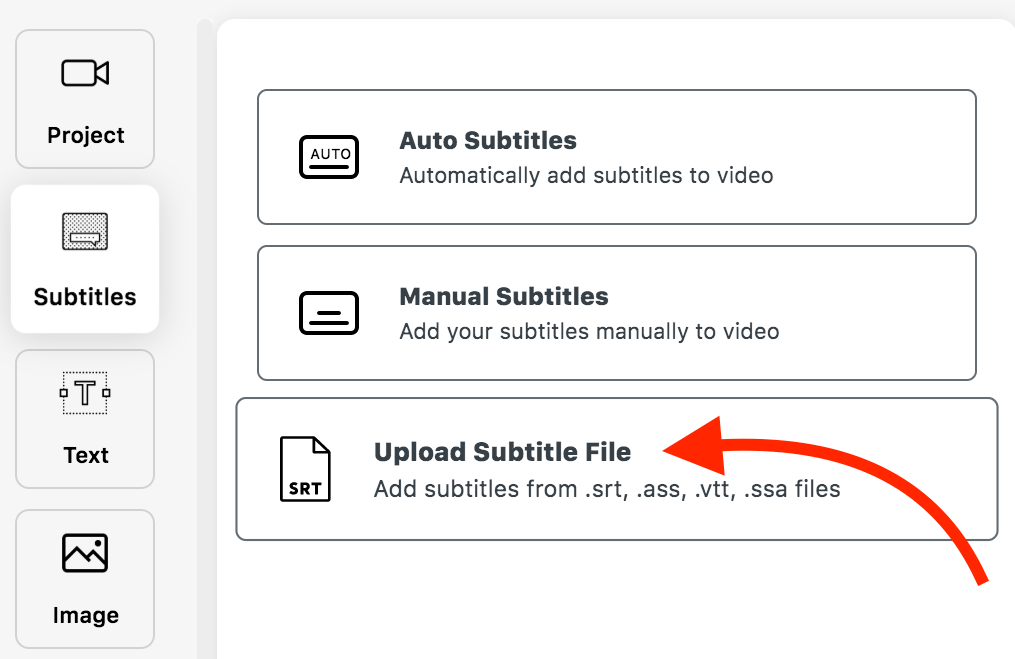
Head over to VEED's auto subtitle generator and create a new project. Click Subtitles in the left toolbar, then upload the SRT file you downloaded from YouTube.
Once the file is in VEED, click the Translate option, click + Add language, and choose Translate automatically. Pick your target language from the dropdown and click Translate. VEED supports 125+ languages, including high-demand markets like Arabic, Persian, Spanish, French, Portuguese, Hindi, Japanese, and Korean.
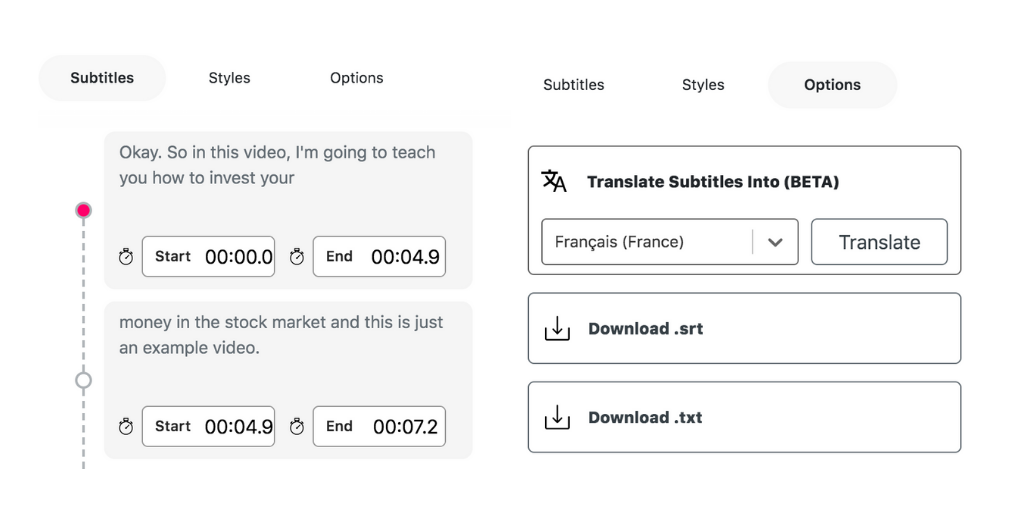
Within seconds, you'll have your translated SRT ready to download. Click Options > Download Subtitles and pick SRT, VTT, or TXT depending on what you need. SRT is the right choice for YouTube uploads.
If your video doesn't have an SRT file yet (or YouTube's auto-captions are too rough to use), you can upload the video itself to VEED instead. VEED's video translator auto-generates subtitles from the audio first, then translates them, all in the same workflow. This is the same pipeline mentioned in our guide to translating videos to English and other languages.
3. Review the translation
This step is non-negotiable. Auto-translation is fast but imperfect, especially for technical language, brand names, idioms, and proper nouns. Read through the translated SRT in VEED's editor and fix anything that looks off. Click any subtitle line to edit the text directly.
A few common things to watch for:
- Brand names and product names often get translated literally. If you say "Apple" referring to the company, some translators will switch it to the local word for the fruit
- Technical terms (especially in coding, finance, or medical content) may not have direct equivalents in every language. Verify with a native speaker or domain expert when stakes are high
- Idioms and slang translate poorly. "Hit it out of the park" makes no sense in most languages. Rewrite for the local market
4. Upload the translated SRT back to YouTube
In YouTube Studio, go back to the Subtitles tab for your video. Click the blue Add language button and select the language of your translated file. A new row appears for that language. Click Add on the far right.
You'll be taken to a page where you can manage the subtitles for the new language. Click Upload a file, choose With timing if your SRT has timestamps (it should), and select the translated SRT file you downloaded from VEED. Click Save once it loads, then Publish in the top-right corner.
Repeat this for as many languages as you want. Many creators target 5 to 10 priority markets based on their audience analytics rather than translating into everything at once.
How to translate a YouTube video without subtitles
A common case: the video you want to watch (or translate) has no subtitle track at all, and YouTube's auto-captions aren't generating either. This happens with music videos, older uploads, or videos where the audio quality is too low for YouTube's speech recognition.
The workflow here is two-step: transcribe first, then translate.
- Download the video. Use a YouTube downloader you trust, or if it's your own video, grab the source file
- Upload to VEED. Drop the video into VEED's auto subtitle generator and click Auto Subtitle. Pick the original language. VEED transcribes the audio in seconds with up to 99.9% accuracy on clean audio
- Translate. Click Translate, + Add language, Translate automatically, and pick your target language
- Export. Download the SRT, or burn the subtitles directly into the video. If you're a creator, upload the SRT to YouTube Studio as covered above
This is where a full pipeline tool beats a Chrome extension. Extensions can't transcribe audio that doesn't already have a caption track. A creation platform can.
Why YouTube auto-translate isn't always enough
YouTube's auto-translate is good for getting the gist of a video. It's not good for anything where accuracy matters. A few specific failure modes worth knowing:
- Accents. YouTube's speech recognition struggles with strong regional accents in the source language, which means errors compound when you translate. A misheard word in the original becomes a mistranslated word in the target language
- Technical terminology. Code, finance, medical, legal, scientific terms often translate literally and lose meaning. "Class" in a programming tutorial becomes "classroom" in some auto-translations
- Brand and proper nouns. Names of companies, products, and people get translated when they shouldn't
- Idioms. Cultural expressions don't survive auto-translation. They translate the words, not the meaning
If accuracy matters (course content, marketing videos, anything going under your brand name), translate the SRT in a dedicated tool, review it line by line, and upload the corrected file to YouTube as a separate language track. Auto-generated translations stay live only as a fallback.
Translating YouTube subtitles into specific languages
A few language markets show especially strong demand for YouTube subtitle translation. Worth calling out if you're a creator deciding which languages to prioritize:
Arabic
Arabic-speaking audiences are heavy YouTube users, and Arabic auto-translate is one of the most-searched language pairs. Arabic is right-to-left, which YouTube handles natively but some third-party tools don't. VEED supports Arabic subtitles with correct directional rendering.
Persian (Farsi)
Persian is another high-demand language for YouTube subtitle translation, especially for educational and entertainment content. Like Arabic, it's right-to-left and benefits from a tool that handles RTL text properly.
Spanish, Portuguese, and Hindi
Spanish and Portuguese open up Latin America, Spain, and Brazil. Hindi opens up the Indian market, which is one of YouTube's largest by daily active users. These three together can multiply a creator's reachable audience by 3 to 5x.
Japanese, Korean, and Chinese
Asian markets are growing fast, but auto-translation quality varies. Japanese and Korean both rely heavily on context and politeness levels that machine translation often misses. Chinese has the added complexity of Simplified vs Traditional characters. Review carefully before publishing.
If you're translating into any of these languages, our guides on translating Chinese videos to English and the broader translate subtitles tool cover the workflow in detail.
Why creators get more out of VEED than a Chrome extension
For viewers, a Chrome extension is enough to watch a foreign-language video in real time. For creators, it isn't.
Translating YouTube subtitles as a creator means producing a usable file you can upload, brand, and reuse. That requires:
- An editable subtitle file in SRT, VTT, or TXT format
- Inline editing to fix mistranslations before publishing
- Style control to match your brand (font, color, animation) when you want hardcoded subtitles instead of toggleable captions
- A way to translate without an existing subtitle track, in case YouTube didn't auto-generate captions
VEED handles all four. The platform generates subtitles from speech in 125+ languages, translates between them, and lets you customize fonts, colors, animations, and dynamic effects to match your brand. You can export an SRT to upload to YouTube Studio, or burn styled subtitles directly into the video for use on TikTok, Reels, Shorts, and other platforms where auto-translate doesn't exist.
The result is video that looks like your brand made it, not AI. For a deeper walkthrough of the subtitle workflow, see our guide to adding auto-subtitles to a video.
Conclusion: which workflow fits you
Here's what to remember:
- Watching a foreign-language video? Click CC, click the gear icon, click Subtitles, click Auto-translate, choose your language. Done in 5 seconds
- Want side-by-side subtitles for language learning? Install Dualsub or Translate and Speak Subtitles for YouTube
- Publishing your own translated subtitles? Download the original SRT from YouTube Studio, translate it in VEED, review the output, upload the new file as a separate language track
- Video has no subtitles to translate? Upload the video to VEED's auto subtitle generator, transcribe first, then translate, then export
- Accuracy matters? Don't trust auto-translate alone. Review every line in a dedicated editor before publishing
🔧 Next step: Translate your first SRT in VEED's subtitle translator. Drop in the file, pick a language, and download the result.
FAQ
To translate subtitles on a YouTube video you're watching, click the CC icon in the player to turn on captions, then click the gear icon and select Subtitles/CC. From there, click Auto-translate and pick your target language. YouTube uses Google Translate to generate translated captions in real time. This works on desktop and the mobile app, and supports 100+ languages.
Auto-translate appears inside the YouTube player's subtitle settings. Click CC to enable captions, click the gear icon, click Subtitles/CC, then click Auto-translate. Pick the language you want from the list. If Auto-translate isn't showing up, the video probably doesn't have subtitles to translate from. YouTube can only auto-translate existing captions, either added by the creator or auto-generated from speech.
YouTube's auto-translate only works when the video already has subtitles. If the creator disabled auto-captions, uploaded a video with very poor audio, or restricted captions to a specific language, the auto-translate option won't show up. Music videos and videos with heavy background noise often fall into this category. To translate one of these videos, download it (if permitted) and upload it to a tool like VEED that can transcribe and translate from the audio.
The easiest method is YouTube's built-in auto-translate. Click CC, then the gear icon, then Subtitles/CC, then Auto-translate, then English. For better accuracy, especially with technical or branded content, download the original SRT (if you're the creator) or rip the captions and translate them in VEED, where you can review and edit each line before publishing.
Yes. The most popular options are Dualsub and Translate and Speak Subtitles for YouTube. Both are free, install through the Chrome Web Store, and overlay translated subtitles on the YouTube player without modifying the original video. Dualsub shows the original and translated subtitles side by side, useful for language learners. Translate and Speak adds spoken playback of the translation. Neither lets you save or publish the translation, so they're viewer tools, not creator tools.
Yes. YouTube's auto-translate supports both Arabic and Persian (Farsi), along with 100+ other languages. Quality is workable for casual viewing but inconsistent for technical content or strong dialects. For higher accuracy, especially when publishing translated subtitles to your channel, translate the SRT in VEED, where you can review and correct line by line. VEED supports both languages with correct right-to-left rendering.