How to Optimize Video Content for AI Search in 2026
%2520(2).png)
When was the last time you asked ChatGPT, Claude, or Perplexity a question instead of Googling it?
If you're like the 800 million people using ChatGPT weekly (OpenAI, October 2025), or the 87% of B2B buyers now using AI chat tools for product research (G2, 2025), you've already experienced the shift from traditional search to AI-powered discovery.
Key Takeaways
- YouTube dominates AI search: 29.5% of Google AI Overviews cite YouTube (BrightEdge, October 2025)
- Early results: Brands see increasingly number of new customers from AI search in 8-12 weeks
- 3-step framework: Audit → Produce → Amplify across YouTube, your website, and Reddit
- Critical elements: Question-format titles, edited transcripts, chapters, schema markup, community validation
- Window: 12 months before competition intensifies
But here's what most brands are missing: AI search doesn't work like Google search.
Google served you 10 blue links and let you decide. AI synthesizes an answer from multiple sources and gives you 2-3 recommendations—often with video demonstrations.
The difference? Traditional search took buyers 2-3 weeks and 8-12 site visits to make a decision. AI search compresses that to 2-3 days.
And if your brand isn't part of that AI-generated answer, you don't exist.
The search landscape has fundamentally changed. According to SparkToro's 2024 research, 59% of Google searches now end without a click to any website—users find their answers directly in AI Overviews, featured snippets, and search results. Meanwhile, discovery is fragmenting across multiple platforms including AI chat tools, Reddit (the #1 most-cited domain in LLM responses), YouTube, and TikTok.
Why YouTube Video Content Dominates AI Search Results (29.5% Citation Rate)
Here's the paradox that creates your opportunity:
- YouTube is the #2 search engine in the world (after Google)
- But video has near-zero representation in AI search results
- When AI models can access video, they cite it 3.1x more often than text (BrightEdge AI Citation Analysis, 2025)
Why? Because AI models are fundamentally different from traditional search engines.
How AI Search Engines Like ChatGPT and Claude Process Video Content
LLMs don't watch videos like humans do. They extract structured data:
Transcripts - Every word spoken becomes searchable, quotable text
On-screen text & captions - Additional context the AI can parse
Visual demonstrations - Frame-by-frame analysis of what's shown
Engagement signals - Watch time, completion rate, likes, comments
Community validation - Where the video is shared and discussed
A 10-minute video tutorial gives an AI model 10 minutes of dense, quotable, verifiable content. A 1,000-word blog post? Maybe 3 minutes of reading time.
Video is data-dense for AI. And right now, most brands aren't treating it as an asset for ChatGPT SEO and AI search visibility.
The Data That Changes Everything
If you're skeptical that this matters, consider:
Google Has Already Made Its Decision
According to BrightEdge's comprehensive analysis of AI citations:
- 29.5% of Google AI Overviews cite YouTube - making it the #1 most-cited domain overall, ahead of Mayo Clinic at 12.5% (BrightEdge, October 2025)
- 300% surge in video citations from August to October 2024 (BrightEdge, October 2024; Search Engine Land, October 2024)
- 25% increase in YouTube citations since January 2024 (BrightEdge, February 2025)
- 78% of product comparison AI responses now include video content (BrightEdge, 2024)
- YouTube receives 200x more citations than any other video platform (BrightEdge, October 2025)
Google isn't testing this. They're scaling it.

Why Video Wins in Multi-Modal Search
AI models prefer video for three fundamental reasons:
1. Machine-Readable Proof
Text can claim expertise: "We're the best project management software."
Video demonstrates expertise: A 10-minute walkthrough showing exactly how to set up project management from scratch, with timestamps for each step.
AI models prioritize demonstrable proof over claims. Video provides that proof in a format they can verify, timestamp, and cite with precision.
2. Verification & Trust
Video is permanent and unchanging. Once published, it becomes a verifiable source that AI can reference repeatedly:
- "At 3:45 in this tutorial, they demonstrate..."
- "According to this video guide published in January 2024..."
3. Multi-Surface Amplification
One video asset becomes 10-15 distribution touchpoints:
Owned:
- YouTube (indexed by all major LLMs)
- Your website (with VideoObject schema for rich results)
- Blog posts (video + transcript + analysis)
- Email nurture (video thumbnails drive engagement)
Social:
- LinkedIn, Twitter/X, Instagram, TikTok (platform-specific cuts)
Community:
- Reddit (the #1 most-cited domain in LLM responses) - Semrush, 2025
- Quora, industry forums, Slack communities
AI-Optimized:
- Structured data (VideoObject schema)
- Standalone transcripts
- FAQ pages with video embeds
One video. Multiple surfaces. Compounding citations.
Video SEO Strategy for AI Search: The 3-Step Framework
Most brands are thinking about video wrong. They're asking: "Should we make videos?"
The right question is: "How do we systematically build video authority that AI models cite?"
Here's the framework:
Step 1: Map Your Video Territory
Don't create random content. Strategically identify where video gives you an unfair advantage.
The 2-Hour Audit:
- Open ChatGPT, Claude, Perplexity, and Google AI Overview
- Ask about your product category: "[Your category] for [your customer type]"
- Ask the follow-up: "Show me a video tutorial about [your core use case]"
- Document:
- Which brands get cited?
- Are videos included in responses?
- What questions are being answered?
- Where are YOUR videos missing?
Then map questions to videos:
Your top 10 high-intent questions should follow this formula:
High-Intent Question + Visual Demonstration Value + Your Differentiation = Video Topic

Step 2: Produce at AI Speed (Not Traditional Speed)
The biggest objection to video: "It's too slow and expensive."
That was true in 2019. It's not true in 2026.
Traditional Video Production:
- 40 hours per video
- $3,000-5,000 per video
- 2-3 videos per month
- = $72K-180K annually for 24-36 videos
AI-Accelerated Production:
- 6-8 hours per video
- $500-800 per video
- 10-15 videos per month
- = $60K-144K annually for 120-180 videos
The difference: 5x more videos for the same (or lower) budget.
How:
Pre-Production (1-2 hours):
- AI script generation from existing FAQs/blog posts
- Auto-generated shot lists and B-roll requirements
Production (2-3 hours):
- Single-take filming with AI teleprompter
- Basic professional setup (one-time $500 investment)
Post-Production (2-3 hours):
- AI editing (auto-cuts, removes silence and filler words)
- Auto-generated captions (edited for accuracy)
- Multi-format export (YouTube, LinkedIn, Instagram, TikTok - one render)

Step 3: Amplify Across Every Surface Where AI Models Look
Creating video isn't enough. You need to distribute it where AI models crawl for citations.
The YouTube + Website Strategy:
Don't choose YouTube OR your website. It's both.
YouTube = AI Citation Engine
- 29.5% of Google AI Overviews cite YouTube (BrightEdge, October 2025)
- 200x more citations than competing video platforms (BrightEdge, October 2025)
- ChatGPT and Claude increasingly pulling from YouTube (SparkToro, March 2025)
- Built-in discovery through YouTube search
Your Website = Owned Authority
- Embed every video with VideoObject schema markup
- Create supporting blog post (video + transcript + additional analysis)
- Add videos to product/category pages
The multiplier effect: One video published both places = 2x visibility, 2x citation opportunities.

The Reddit Multiplier:
Here's the secret most brands miss: Reddit is the #1 most-cited domain in LLM responses (Semrush, 2025).
And Reddit is full of people asking for video tutorials, product comparisons, and demonstrations.
The Citation Flywheel:
- Create video answering genuine high-intent question
- Optimize for YouTube (question-format title, edited transcript, chapters)
- Share authentically in relevant Reddit communities (not spam - genuine helpfulness)
- Reddit upvotes = authority signal for both Google and LLMs
- LLMs crawl Reddit, see highly-upvoted video
- LLM cites Reddit thread + your video in response
- More traffic → more engagement → more authority → loop
When you connect Reddit (#1 cited domain) with YouTube (#3 cited domain), you create an authority engine that compounds.

5 Video Optimization Techniques That Increase AI Search Citations by 3x
Not all videos get cited. Here are the 5 elements that make video 3x more likely to appear in LLM responses (SweetFish Media, 2024; BrightEdge, 2024):
1. Question-Format Titles
❌ Bad: "Product Demo 2024"❌ Bad: "How to Use Our Software"✅ Good: "How to Remove Video Background in 5 Minutes (No Green Screen)"✅ Good: "Asana vs Monday.com: Which Project Management Tool Should You Choose?"
Why it works: LLMs prioritize question-answer format matching.
2. High-Quality Transcripts
❌ Bad: Auto-generated only (full of errors, no punctuation)✅ Good: Edited transcript with proper punctuation and capitalization✅ Better: Natural, quotable language that an AI would want to cite
Why it works: LLMs literally read your transcript to decide if they should cite you. Make it citation-worthy.
3. Structured Chapters
❌ Bad: Single 10-minute block, no timestamps✅ Good: 5-7 chapters with descriptive titles
Example:
- 00:00 - Introduction: Why Background Removal Matters
- 01:30 - Problem: Traditional Green Screen Limitations
- 03:45 - Solution: AI-Powered Background Removal Walkthrough
- 07:20 - Common Mistakes to Avoid
- 09:10 - Next Steps & Advanced Techniques
Why it works: Helps AI models find and cite specific segments: "At 3:45, this video demonstrates..."
4. Website Embedding + Schema Markup
Don't just put video on YouTube. Embed it on your website with VideoObject schema.
Schema markup is structured data that tells search engines:
- "There's a video here"
- "It's about [topic]"
- "It's [duration] long"
- "It was published on [date]"
This makes you eligible for rich results (video thumbnails in search results) and helps AI models understand your video's context.
The data: Videos embedded on websites with proper schema see 78% higher click-through rates in search results (Semrush, 2024).
5. Community Validation
❌ Bad: Upload and forget
✅ Good: Share in relevant Reddit communities, industry forums, Slack groups (authentically)
✅ Better: Engage with comments, build authority in the community
Why it works: Upvotes, comments, and shares are authority signals that both Google and LLMs use to determine trustworthiness.
Video Content Types That Rank Best in AI Search (With Examples)
Not all videos are created equal for AI discovery. Here's how to think about your content mix:
🏆 Tier 1: Hero Tutorials (10-15 min)
What: Deep-dive, comprehensive guidesExamples: "Complete Guide to Video SEO," "How to Build a Content Calendar from Scratch"Frequency: 1-2 per monthWhy: These get cited most in LLM responses—they're comprehensive, quotable, and authoritative
📊 Tier 2: Comparison Content (5-8 min)
What: Side-by-side product evaluationsExamples: "[Your Product] vs [Competitor]," "When to Use [Feature A] vs [Feature B]"Frequency: 2-3 per monthWhy: High-intent, consideration-stage searches. Buyers are close to decision.
⚡ Tier 3: Quick Tips (1-3 min)
What: Bite-sized, single-concept videosExamples: "How to [Micro-Task] in 60 Seconds," "[Feature] Explained"Frequency: 8-12 per monthWhy: Volume = surface area for AI discovery. Fills specific knowledge gaps.
🎬 Tier 4: Product Updates (2-4 min)
What: Feature launches, releases, announcementsExamples: "New Feature: What It Does," "Q4 2024 Product Updates"Frequency: Weekly/bi-weekly as neededWhy: Signals freshness to AI models. Recent content gets priority.
The Strategy:
- Tier 3-4 = Discovery (Volume helps you get found)
- Tier 1-2 = Authority (Depth gets you cited and trusted)
- All Tiers = Conversions (Get customers)
You need volume to get discovered. You need depth to build authority. You need both to win AI search.
90-Day Video SEO Implementation Plan for AI Search Visibility
You don't need a year to see if this works. You need 90 days.
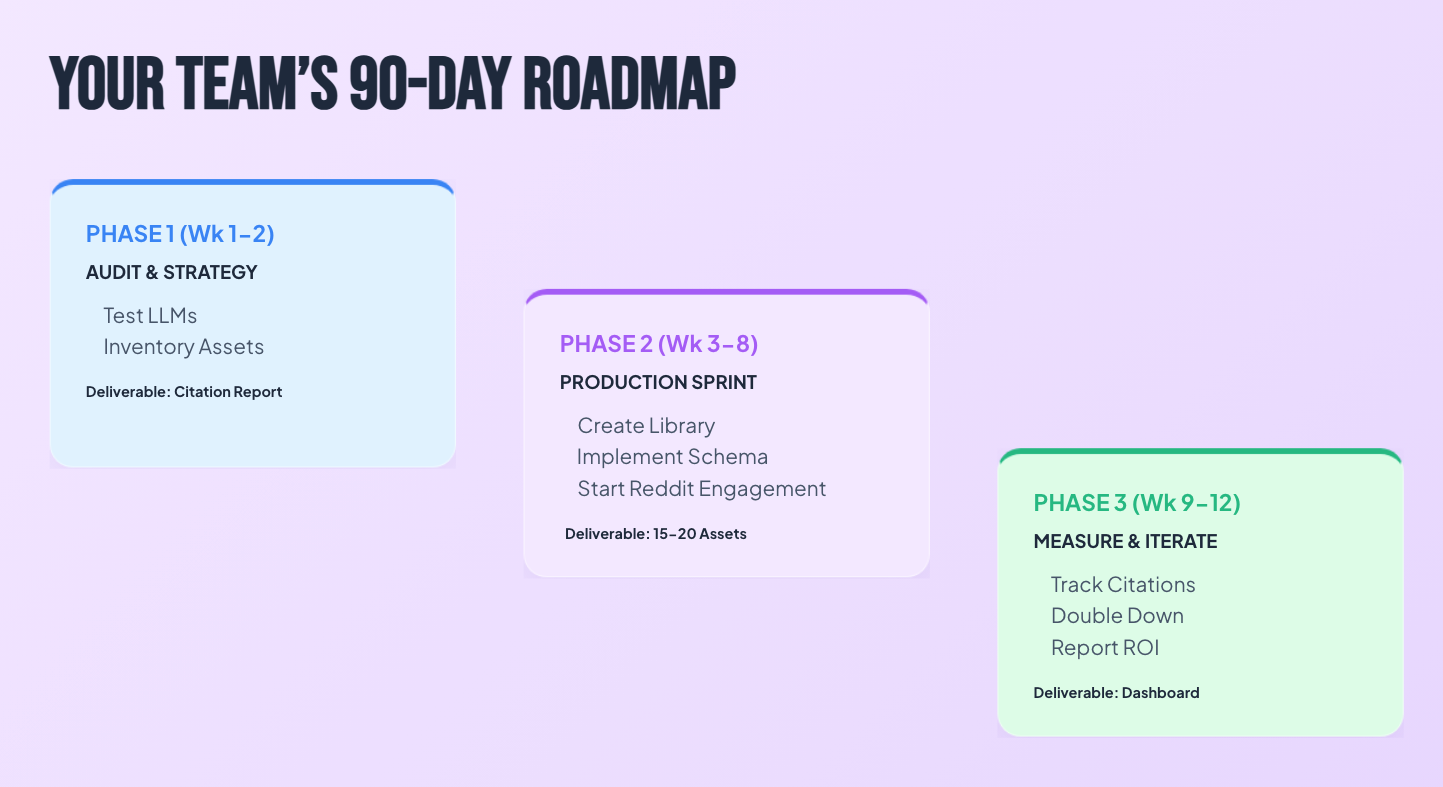
Weeks 1-2: Audit & Strategy
Your Category:
- Test all major LLMs (ChatGPT, Claude, Perplexity, Google AI) for your core searches
- Document: Who gets cited? Are videos included? What questions are answered?
- Identify your top 10 questions you should own
Your Competitors:
- Which brands appear consistently?
- What content types are they using?
- Citation analysis: What makes them quotable?
- Backlink analysis: What's their backlink profile and link-building strategy?
Your Assets:
- Inventory existing video content
- Assess production capability (in-house vs partner)
- Budget planning & reallocation
Deliverable: LLM citation report + Top 10 video topics prioritized + 90-day content calendar
Weeks 3-8: Production Sprint
Create Your Video Library:
- 2-3 Hero tutorials (10-15 min each)
- 3-4 Comparison videos (5-8 min each)
- 8-10 Quick tips (1-3 min each)
- 2-3 Product updates (as relevant)
Optimize Everything:
- Implement VideoObject schema on website
- YouTube: Question titles, edited transcripts, structured chapters
- Create supporting blog posts with video embeds
- Build video sitemap
Start Distribution:
- Identify 5-7 relevant subreddits
- Build Reddit karma (authentic engagement first—no spam)
- Join industry Slack/Discord communities
- Set up social distribution schedule
Deliverable: 15-20 video assets published + Full website integration + Community presence established
Weeks 9-12: Measure & Iterate
Track Performance:
- Weekly LLM citation checks (manual: ChatGPT, Claude, Perplexity, Google AI)
- YouTube Analytics deep dive (watch time, traffic sources)
- GA4: AI referral traffic analysis
- Reddit/community mention velocity
Optimize Based on Data:
- Double down on videos getting cited
- A/B test: Question titles vs keyword titles
- Refine transcript quality and structure
- Expand to new communities
Report to Leadership:
- Citation growth chart
- Traffic & conversion attribution
- Cost per acquisition comparison
- Next 90-day plan
Deliverable: Performance dashboard + ROI analysis + Roadmap for next quarter
By Day 90, You'll Know:
- Is AI search a viable channel for your business? (Early signals appear by Week 6)
- What content types get cited most in your category?
- What's your true customer acquisition cost from this channel?
- How to scale for the next 90 days
Three Actions You Can Take This Week
You don't need to overhaul your entire content strategy tomorrow. Start with these three actions:
1. The 10-Minute Test (Do This Today)
In your next team meeting:
- Open ChatGPT and Claude
- Ask: "[Your product category] for [your ideal customer profile]"
- Ask: "Show me a video tutorial about [your core use case]"
- Document:
- Are you mentioned anywhere?
- Which competitors get cited?
- Are videos included in responses?
- What's the quality bar they're setting?
Screenshot it. Share with your team. That's your baseline reality check.
2. The Budget Reframe (Review This Week)
Don't think: "We need NEW video budget."
Think: "Where are we spending on discovery channels that are declining?"
Reallocation candidates:
- Paid search (CPCs rising 15-20% YoY, AI disrupting click behavior)
- Display ads (banner blindness accelerating)
- Low-ROI content marketing (text-only blog posts with <100 monthly visits)
- Trade shows with poor attribution
Shift to: Video-first AI search strategyExpected ROI: 60% lower CAC based on early adopter data
3. The Alignment Meeting (Calendar Within 2 Weeks)
Book a 90-minute working session with:
- Content lead
- SEO lead
- Product marketing
- Creative/video (if you have)
- One exec sponsor
Agenda:
30 mins: Share LLM audit results
- Show competitor citations
- Discuss opportunity size
30 mins: Brainstorm top 10 video topics
- Use the production hierarchy framework
- Prioritize by intent + differentiation + your unique value
30 mins: Assign owners & timeline
- Who scripts? Who produces? Who optimizes?
- When can we publish first 5 videos?
- What resources do we need?
Output: First 5 videos in production by Week 4
The Window Is Closing
Here's what you need to understand about timing:
2024-2025: Early Adopter Advantage ← WE ARE HERE
- Low competition in AI search citations
- LLMs still learning which sources to trust
- First-movers establishing category authority
- You can win your category in 90 days
2026-2027: Competitive Parity
- Everyone figures out video-first AI search
- Citation competition intensifies
- Requires 3x the effort for same results
- You're fighting for scraps
2028+: Pay-to-Play
- AI search advertising launches (likely scenario)
- Organic visibility harder to achieve
- Similar to Google's evolution (2000 → 2015)
- You're buying what you could have owned
The Historical Pattern
First-movers in SEO (2000-2005): 3-5x more visibility than fast-followersEarly YouTube adopters (2010-2015): 10x more subscribers than late entrantsEarly podcast pioneers (2015-2020): Dominant category positions today
New discovery channels reward early strategic investment with sustained advantage.
Right now, you can establish authority with smart content.
Wait 18 months, and you'll compete for what's left.
Wait 3 years, and you'll pay for what could have been free.
The Strategic Question You Should Be Asking
What if 20% of your customers are already using AI search to find solutions... and you're completely invisible in those conversations?
Not "if." When.
The shift is happening now. The question is whether you're part of it.
The Bottom Line
Video isn't the future of search. It's the present—for those paying attention.
AI models prefer video because it's verifiable, quotable, and demonstrates expertise in a way text cannot.
Google has already chosen video, citing YouTube in nearly 30% of AI Overviews (BrightEdge, October 2025).
Early movers are capturing 5-10% of new customer acquisition from this channel, with 60% lower CAC than paid search.
The window is 12-18 months before this becomes common knowledge and competition intensifies.
The brands winning in 2026 are building their AI search presence today.
Are you one of them?
Sources & Further Reading
Primary Research & Data:
AI Search & Citations:
- BrightEdge (October 2025). "AI Citation Analysis: YouTube dominance in AI search." YouTube cited in 29.5% of Google AI Overviews, making it the #1 most-cited domain.
- BrightEdge (February 2025). "YouTube Citation Growth Analysis." 25% increase in YouTube citations since January 2024.
- BrightEdge (2024). "Video Citation Analysis." 300% surge in video citations from August to October 2024; 78% of product comparison AI responses include video content; YouTube receives 200x more citations than any other video platform.
- Search Engine Land (October 2024). "YouTube Citation Growth in AI Overviews." Reports on 300% surge in video citations.
- Advanced Web Ranking (November 2025). "AI Overview Inclusion Study." Over 60% of searches now include AI Overviews as of November 2025.
Search Behavior & Market Share:
- SparkToro (March 2025). "Google vs. ChatGPT Search Volumes." Google processes 14 billion searches daily; Google received 373x more searches than ChatGPT in 2024; ChatGPT has 0.25% search market share vs Google's 93.57%.
- SparkToro (2024). "Zero-Click Search Study." 59% of Google searches in the U.S. end without a click to external websites; almost 30% of clicks go to Google-owned properties.
- SparkToro (December 2024). "Analysis of 332 Million Google Queries." Research covering January 2023 – September 2024 on search behavior, intent, and demand distribution.
- SparkToro (November 2025). "The Pinball Customer Journey." Modern customer discovery happens across multiple touchpoints including WhatsApp, Substack, Instagram, Reddit, YouTube, and AI chat tools.
- OpenAI (November 2024). "ChatGPT User Statistics." 800 million weekly active users reported.
B2B Buyer Behavior:
- G2 (2025). "How AI Chat is Rewriting B2B Software Buying [Insights From 1,000+ Decision Makers" 87% of B2B buyers now use AI chat tools for product research.
Video SEO & Schema:
- Semrush (2024). "Video Schema Study." Videos embedded on websites with proper VideoObject schema see 78% higher click-through rates in search results.
- Semrush (2024). "Most Cited Domains Study." Reddit identified as the #1 most-cited domain in LLM responses, with YouTube as #3.
- SweetFish Media (2025). "Video Ranking Study for AI Search." Analysis of elements that make video 3x more likely to appear in LLM responses.
- Semrush (2024). "ChatGPT Usage Analysis." Only 30% of ChatGPT prompts have "search-like" intent; median conversation involves three messages.
Additional Sources:
- GoDataFeed (2024). "AI Overview Analysis." Comparison of product page vs video citations.
- Google/Sundar Pichai (2024). Public statements on AI Overviews increasing search usage and user satisfaction.
FAQ
Video SEO for AI search is the practice of optimizing video content so AI search engines like ChatGPT, Claude, Perplexity, and Google AI Overviews can find, understand, and cite your videos. This includes optimizing video titles with question formats, adding edited transcripts, creating structured video chapters, implementing VideoObject schema markup, and distributing videos across YouTube and your website. Proper video SEO increases the likelihood of your content being cited by 3x.
To optimize YouTube videos for AI search:
1) Use question-format video titles that match search queries
2) Upload edited transcripts with proper punctuation (not auto-generated)
3) Add structured video chapters with descriptive timestamps
4) Write 200-300 word video descriptions with natural keywords
5) Share videos authentically on Reddit and relevant communities for validation signals. YouTube appears in 29.5% of Google AI Overviews, making it the #1 cited platform.
The best video optimization techniques for SEO in 2025 are:
1) Question-format video titles, based on keyword/prompt research (e.g., 'How to [task]' not 'Product Demo')
2) High-quality edited video transcripts for searchability
3) Structured video chapters with timestamps (5-7 chapters per video)
4) VideoObject schema markup on your website
5) Community validation through Reddit and forum sharing. Videos with these optimizations see 78% higher click-through rates and 3x more AI citations.
VideoObject schema is structured data markup that tells search engines and AI models exactly what your video contains, including title, description, duration, upload date, and thumbnail. Adding VideoObject schema to embedded videos on your website increases click-through rates by 78% and makes your content eligible for rich video results in Google Search. It helps AI search engines understand and index your video content more effectively, leading to higher citation rates.
You should optimize videos for BOTH your website and YouTube for maximum video SEO performance. YouTube provides 29.5% of Google AI Overview citations and built-in discovery through YouTube search. Your website with VideoObject schema markup creates owned authority and earns 78% higher click-through rates. Publishing the same video on both platforms with proper optimization creates 2x visibility and 2x citation opportunities in AI search results.
From our experience, tutorial videos (10-15 minutes), comparison videos (5-8 minutes), and how-to guides rank best in AI search results. These video formats provide comprehensive, quotable content that AI models can cite with specific timestamps. Tutorial videos get cited most frequently because they're authoritative and demonstrate expertise. Product comparison videos capture high-intent searches where buyers are close to decisions. Quick tip videos (1-3 minutes) provide volume for discovery across multiple search queries.